What happens when elephants urgently need water – but damage the very infrastructure that provides it? In NG3 in Botswana, a current project shows how a relatively simple structural change can make a big difference.
During the dry season, water becomes a vital resource for people, livestock and wildlife in northern Botswana. Elephants in particular depend on reliable water sources. At the water points we support in the NG3 area, investments have therefore repeatedly been made in the water supply over the past few years.
The problem: elephants are looking for fresh water.
At the western borehole, a higher-than-expected influx of elephants was observed earlier than usual this year. This created a particular problem: the pumped fresh water flowed through an outlet directly into the waterhole, where it immediately mixed with the muddy water.
The elephants then tried to reach the source of the fresh water. In the process, pipes and outlets were damaged. From a human perspective, this causes damage to important infrastructure. From the animals’ perspective, however, the behaviour is understandable: they are looking for water and trying to reach its source.
The question, therefore, was not how to prevent this behaviour, but rather: How should a water point be designed so that it also works for elephants?
A solution that has already proven successful
The answer could already be found just a few kilometres away. At the eastern borehole near Morama, a second water outlet had been equipped with ground-level, steel-reinforced concrete troughs.
Fresh water first flows into the concrete troughs, where elephants can drink directly. Only the overflow then continues into the actual waterhole. This keeps fresh water immediately accessible while reducing the incentive for the animals to search for pipes and other parts of the water infrastructure. This approach has proven successful in Morama. It was therefore decided to implement the same design at both outlets of the western borehole.
Work begins
The work was carried out step by step to ensure that water remained available to the elephants throughout the construction. First, a new concrete trough was built at the eastern outlet while water continued to be pumped through the western outlet. The water flow could then be redirected to the eastern side, allowing the damaged western outlet to be repaired. The work was carried out with local workers and a team on site.
Around €2,450 for a concrete solution
The estimated total cost of the current measures is 38,466 Botswana pula – approximately €2,450.
This includes:
- construction materials and stones for the concrete
- transport to the project site
- meals for the team
- technical supervision and local labour
- generator maintenance
- fuel for two months of nighttime pumping
Some of the materials were purchased before work began. One corresponding materials invoice, for example, documents expenses of 6,381.60 pula.
And then the elephants came
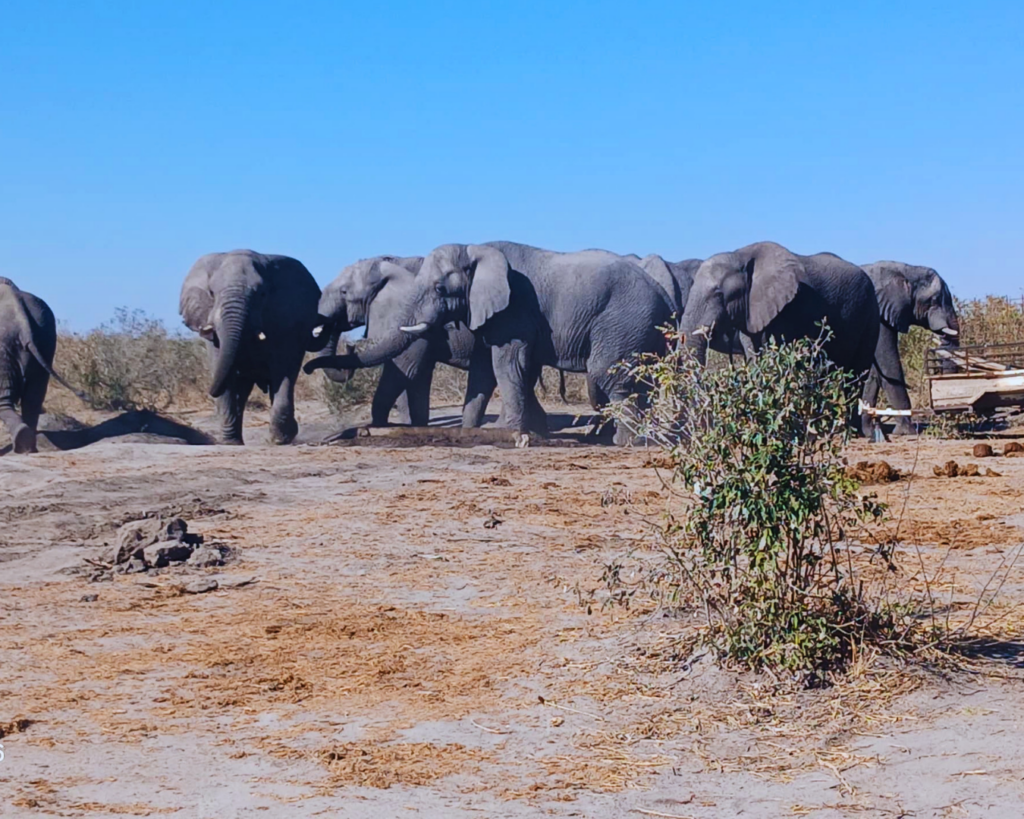
Only a short time later, the new concrete trough was complete. And the first visitors did not take long to arrive.
Recent footage from the site initially shows a single elephant right next to the new structure. A little later, an entire herd had already gathered at the water point. This immediately demonstrates the difference that a comparatively simple adaptation of the infrastructure can make. Fresh water remains accessible to the animals, while pipes, pumps and other technical components are better protected.
Water supply as part of elephant conservation
As early as the end of 2024, SAVE Wildlife Conservation Fund, together with ECF and Future for Elephants, supported several measures at the water points in NG3. At the western borehole, these included replacing a pump and solar panels damaged by elephants, restoring the eastern pipeline, enabling nighttime pumping with the help of a generator, and protecting the solar equipment with an electric fence.
At the eastern site near Morama, a second outlet was installed, including the ground-level concrete troughs whose design is now also being used at the western site. The current project also shows that wildlife conservation does not always require a large or technically complex intervention. Sometimes it is about carefully observing how animals use existing infrastructure – and adapting that infrastructure accordingly.
In this way, conflicts can be reduced, existing investments protected and wildlife provided with a reliable source of water. Coexistence does not mean that wildlife has to learn how to deal with our infrastructure. We need to develop solutions that work with their natural behaviour.
Protecting wildlife together
With comparatively modest resources, measures like these can have an immediate impact on the ground. If you would like to support SAVE Wildlife Conservation Fund in securing water points and implementing further projects to protect elephants and other wildlife, you can support our work with a donation.