Search

Generic selectors
Exact matches only
Search in title
Search in content
Post Type Selectors
Education programmes

Botswana & DR-Kongo

Support education today

EDUCATION FOR CONSERVATION

Education is one of the two key pillars of our Education 4 Conservation strategy for protecting wildlife.
Many children in Africa grow up facing social and economic disadvantage. Many have had little opportunity to explore their local natural environment and have never visited a national park. They often fear wild animals, which can seem to be there only for tourists.
Our educational programmes for children and young people include early childhood learning and development playgroups, preschool care and activities, school holiday programmes, homework clubs and access to scholarships. Children in need receive meals and, where necessary, psychological support.
We aim to introduce children to wildlife conservation from an early age and help them appreciate the unique value of their surroundings, nurturing their desire to protect them.
Adults in the region are also often unaware of the opportunities that conservation and ecotourism can offer. Our educational programmes help them understand the value of nature and its connection to sustainable development and new possibilities for their country’s future.

Umweltbildbung Lehrerin Botswana

“The playgroups help children get off to a good start at primary school.”

— Gakenaope Dimbere, SAVE Area Coordinator, Shakawe Community

Problem:
Educational gaps, disconnection from nature, biophobia and loss of knowledge

Goal:
Reach 90% of children in Wildlife Contact Areas with environmental education.

Our approach to wildlife conservation

Our commitment to protecting threatened species takes a comprehensive approach: educational programmes for children, early childhood education, homework clubs, school holiday programmes, scholarships and community outreach, with a particular focus on environmental education.
We believe that education that starts early and provides a broad foundation is key to preserving biodiversity and protecting our environment.


Where SAVE nurtures young conservationists:

Botswana Around the Okavango Delta, we run 40 active playgroups for children aged three and above—in Ngamiland, Boteti, Chobe, Shakawe and Tutume Central. For older children and young people, we offer after-school environmental education programmes covering conservation, ecological relationships and career opportunities in ecotourism.

Democratic Republic of the Congo Around Virunga National Park, we run four playgroups—in Kanyabayonga, Vitshumbi, Kabaya and Rumangabo. For children growing up amid conflict and displacement, these are often the only safe spaces they have access to during the day. In 2025, we also raised environmental awareness among 897 pupils and 34 teachers at nearby primary schools and planted 155 trees together.

Botswana

Environmental education in the Okavango Delta

Environmental education in the Okavango Delta
Add an optional description to your map pin.

Democratic Republic of the Congo

Environmental education around Virunga National Park

Environmental Education at Virunga National Park

SAVE education programmes
for wildlife conservation

Bildung für den Artenschutz Botswana, Afrika, DR-Kongo

Daily playgroups: Early Childhood Development (ECD)

Playgroups for children aged three and above
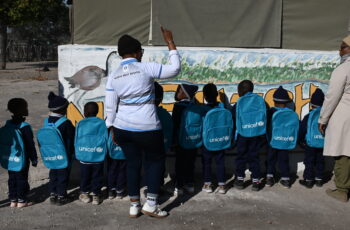
In the wildlife areas of Botswana and the Democratic Republic of the Congo, access to public preschool education is very limited. Our playgroups help bridge this gap, combining foundational literacy and numeracy skills with environmental education and psychosocial support. A typical day includes free play at activity stations, storytime, creative activities in workbooks and shared meals. Where needed, children also receive school uniforms, snacks and basic first aid. In conflict-affected regions such as North Kivu, the playgroups are often the only safe spaces children can access during the day. More than 1,500 children each year. Over 20,000 children reached since 2010. Every year, several hundred children successfully complete preschool.

After-school environmental education (EE)

Conservation for children and young people aged 6–18
As children grow older, the topics evolve. Playful exploration develops into an understanding of ecological relationships: What is an ecosystem? Why do lions need prey? How can people earn a living from wildlife without shooting animals?
We work with schools and youth groups in wildlife areas, organising visits to wildlife reserves and crocodile farms, activity days and career guidance in ecotourism. Wildlife once perceived as a threat becomes connected with tangible career opportunities—as rangers, guides, wildlife researchers or environmental educators. What we do: After-school programmes at primary schools near wildlife areas
Field trips, talks and shared activity days
Career events exploring opportunities in conservation and ecotourism
School gardens and experimental growing plots, often combined with tree planting activities involving the children

Teacher training:
Empowering teachers multiplies the impact

Our educational work is only as effective as the people who deliver it every day. That is why we invest in professional development for local teachers, focusing on participatory teaching, play-based learning and integrating environmental topics into the national curriculum.

We provide multi-day training for playgroup teachers, emphasising methods that work even with limited materials and in unstable settings. Practical activities regularly include planting trees together and germinating seeds, giving teachers first-hand experience of what they teach. We also provide first aid training and involve parents through regular parent meetings.

Our work in practice:

  • More than 100 teachers involved in our educational programmes
  • Regular in-house training in Botswana and the Democratic Republic of the Congo
  • Multi-day intensive training focused on participatory teaching methods
  • Parents actively involved through annual parent meetings
Lehrerfortbildung stärkt Umweltbildung in kongolesischen Spielgruppen

„Early Childhood Development Curriculum” – das SAVE Schul- und Lehrbuch

The “SAVE Early Childhood Development Curriculum” forms the foundation of children’s nature and environmental education. Developed by SAVE specifically for teachers, it is used from preschool onwards. An accompanying workbook supports hands-on activities, helping children learn about the environment and appreciate the value of nature through play.

Achievements


Linie
0

Active projects
for children

0

Children reached through environmental education

Kinder
0

23.5 million hours of learning for children since 2010

How you
can help

Children in low-income countries often have limited access to education. Many grow up in conflict-affected areas where people and wildlife compete for scarce resources. These experiences can lead children to fear nature and see it as a threat.
Your donation helps us give children access to education.

Wildlife conservation starts with education—donate now!

Education alone is not enough

To turn knowledge into action, we combine our educational programmes with support for children’s families—from climate-smart agriculture to women’s empowerment.

Latest news from our educational programmes